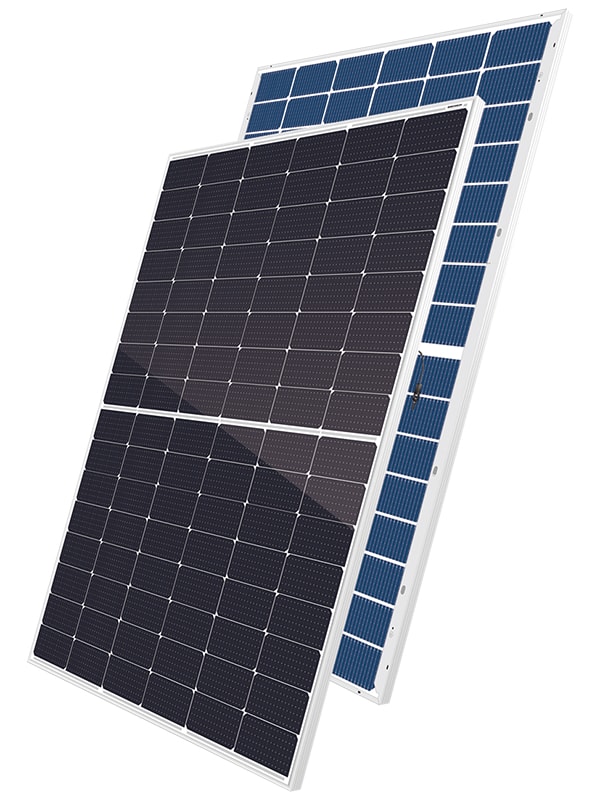
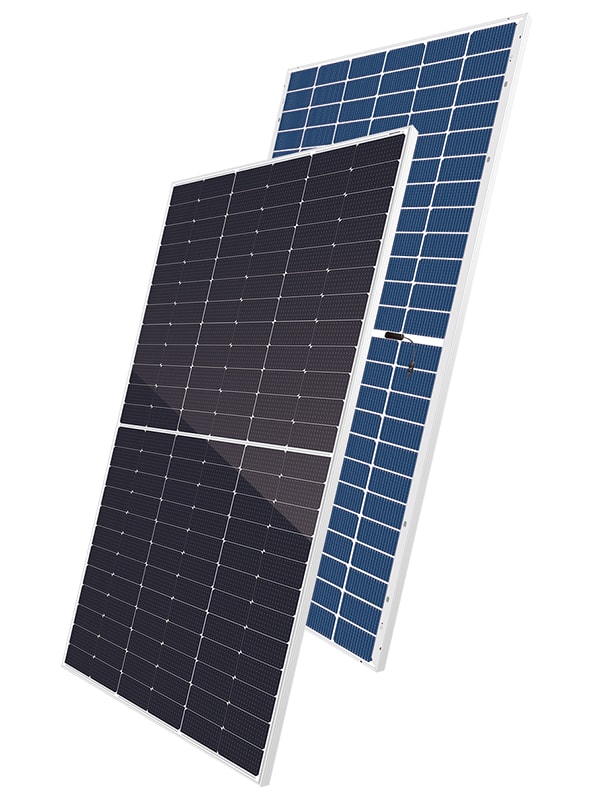
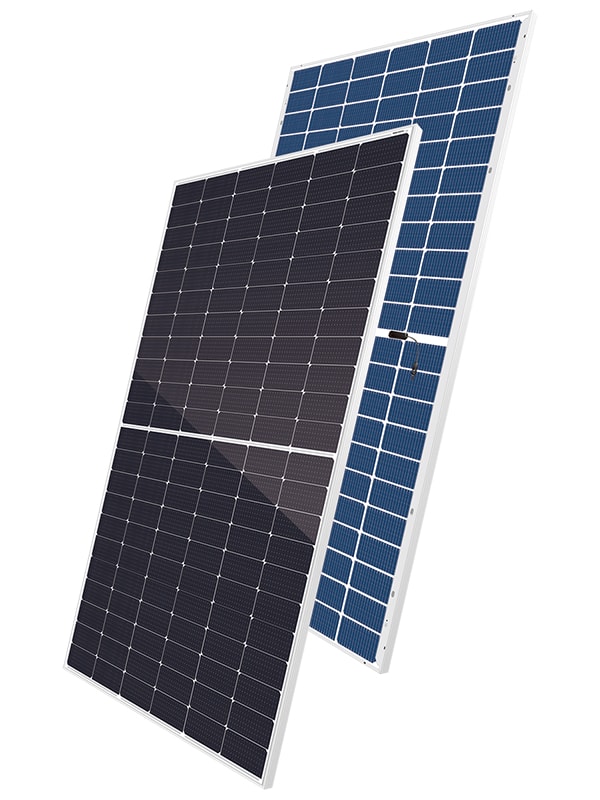
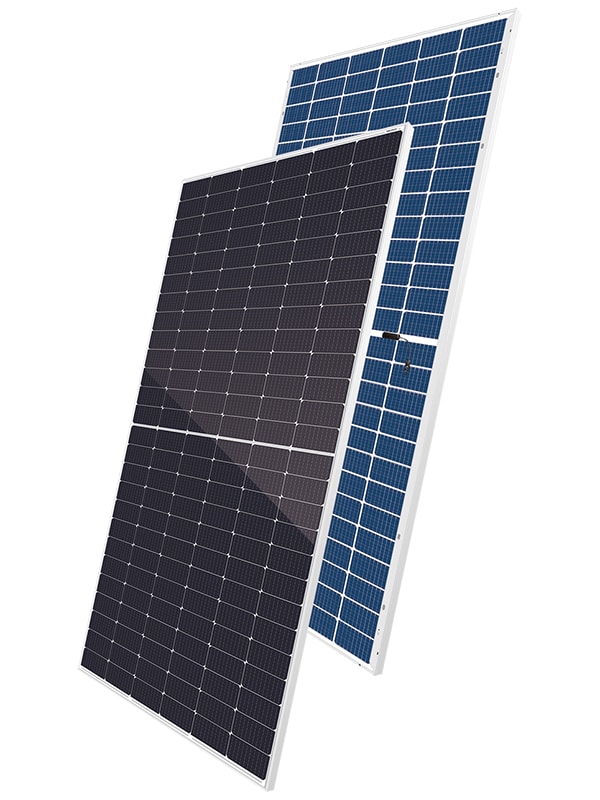
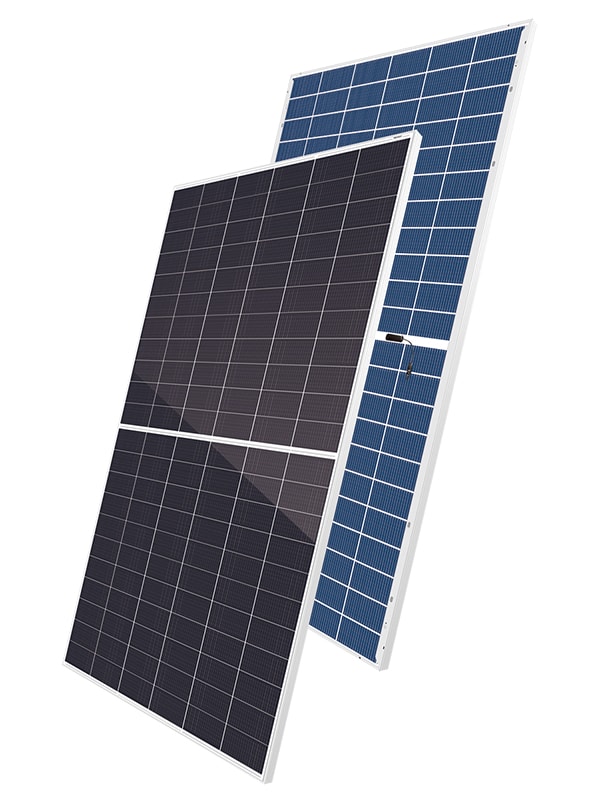
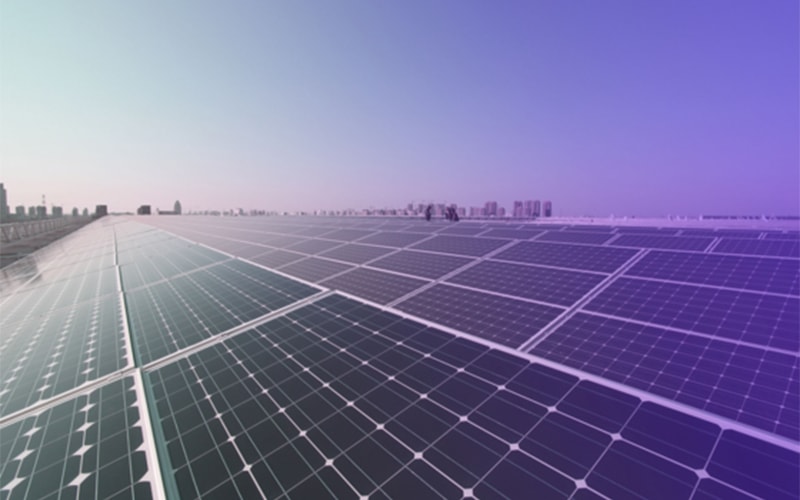
Huangming’s N-type TOPCon bifacial PV module features next-generation N-type TOPCon cell technology and a bifacial design, significantly improving conversion efficiency, power output, long-term power degradation control, and operational reliability, compared with a conventional mono PERC module.
The solar modules are integrated with N-type silicon wafers, TOPCon passivated contact technology, and an MBB half-cell design, reducing electrical losses and improving conversion efficiency. Meanwhile, the bifacial design allows the backside to use reflected sunlight to generate additional power.
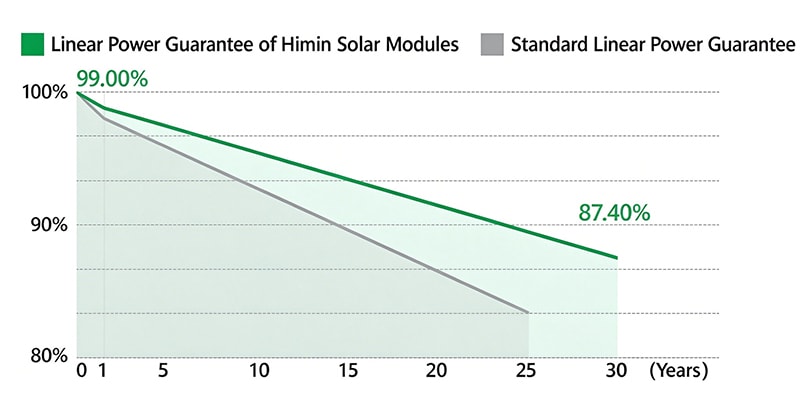
Compared with a P-type mono PERC module, the N-type TOPCon bifacial PV module exhibits lower light-induced degradation (LID) and provides better high-temperature performance and higher long-term energy yield. Our solar modules exhibit a first-year power degradation of less than 1.0%, followed by a linear degradation rate of 0.40% per year from years 2 to 30.
Our TOPCon solar panels, available in power classes ranging from 450 W to 730 W, are suitable for residential rooftops, commercial and industrial rooftops, solar carports, and utility-scale ground-mounted PV plants.
Our available N-type TOPCon bifacial PV modules
450W bifacial dual-glass module
Module Dimensions: 1762 × 1134 × 30 mm
Weight: 24.5 kg
Maximum Power: 440-465 W
Module Efficiency: 22.02%-23.27%
Maximum Power (25% Backside Gains) : 550-581 W
12-year product warranty Data Download:
710–730W bifacial dual-glass module
Module Dimensions: 2384 × 1303 × 33 mm
Weight : 37.5 kg
Module Efficiency : 22.86%-23.50%
Maximum Power (25% Backside Gains) : 888-913 W W
12-year product warranty Data Download:
Features
1. High power output: The N-type TOPCon bifacial PV module features multi-busbar (MBB) half-cell technology to improve power density and deliver higher module output.
2. Low power degradation: First-year power degradation is < 1.0%, followed by a linear degradation rate of 0.40% per year from years 2 to 30.
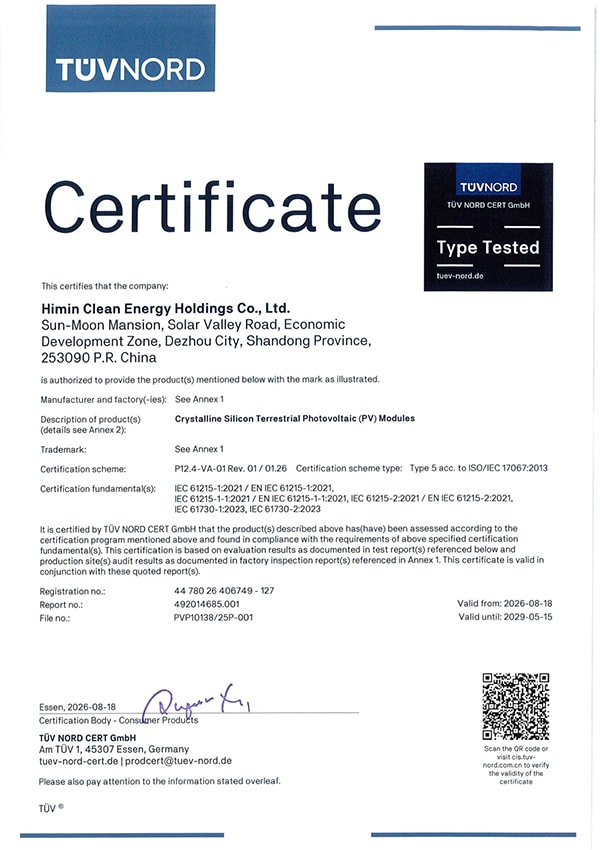
3. High reliability: TÜV-certified for salt-mist and ammonia-corrosion resistance, with wind-load testing up to 2,400 Pa and snow-load testing up to 5,400 Pa.
4. Low temperature coefficient: A low temperature coefficient helps reduce power loss at elevated module temperatures, supporting higher energy yield under real-world operating conditions.
5. Excellent low-light performance: Delivers better performance than conventional modules under low-irradiance conditions, such as cloudy or hazy weather.
6. No Boron-Oxygen LID: N-type cells are not subject to boron-oxygen (B-O) complex-induced LID, helping maintain long-term energy yield.
Applications
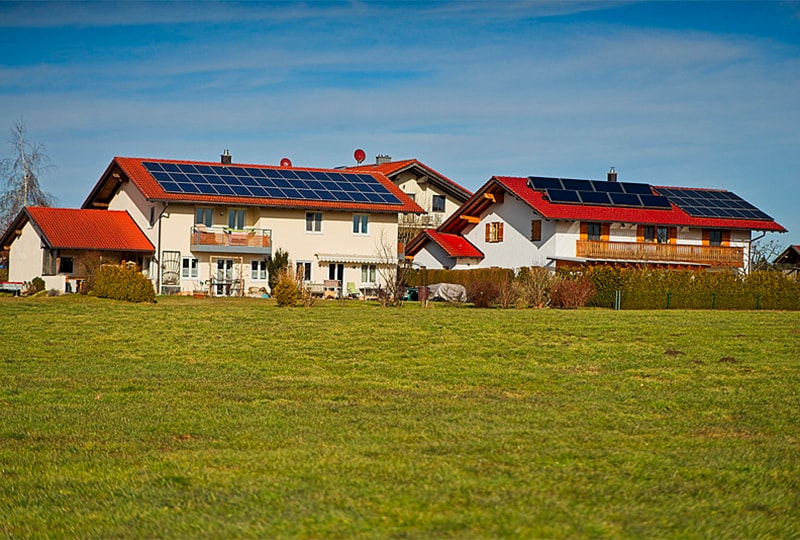
Solar modules mounted on household rooftops.
They capture solar radiation and generate electricity for daily use, such as lighting, home appliances and air‑conditioning.
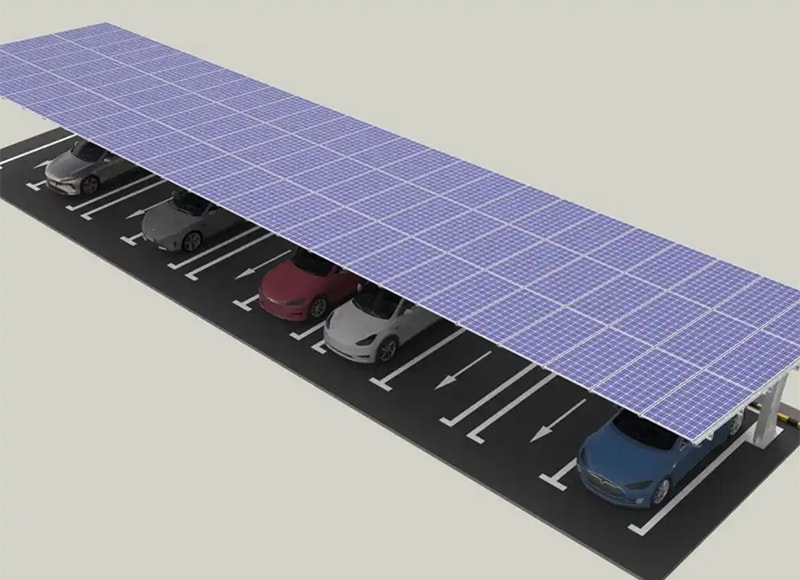
A solar carport.
The PV panels installed above generate clean solar power while providing shade and rain protection for parked vehicles. The electricity produced can be used for EV charging and on-site consumption, making full use of the parking space.
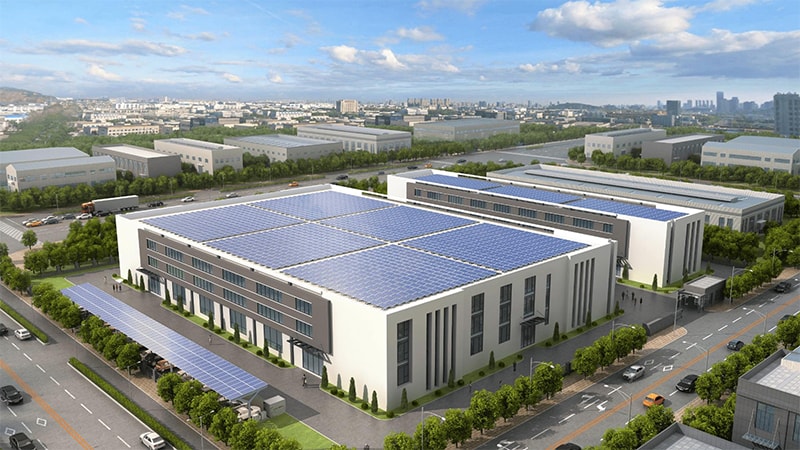
PV modules on the metal rooftops of industrial plants.
They convert sunlight into electricity for factory production and office power consumption, helping enterprises cut grid electricity costs and realize low‑carbon manufacturing without occupying extra land area.
A ground-mounted PV power plant.
Large-scale solar arrays are mounted on open areas to generate large amounts of clean electricity. The generated power is fed into the grid. They are suitable for large areas of underutilized land and can deliver reliable renewable energy for cities and industrial users.
Linear Performance Warranty
12 YEARS Product warranty 30 YEARS Linear power warranty 0.4% Annual power degradation from years 2–30
Certifications
● ISO 9001:2015 Quality Management System Certification
● ISO 14001:2015 Environmental Management System Certification
● ISO 45001:2018 Occupational Health and Safety Management System Certification
● IEC 62941:2019 PV Module Manufacturing Quality System
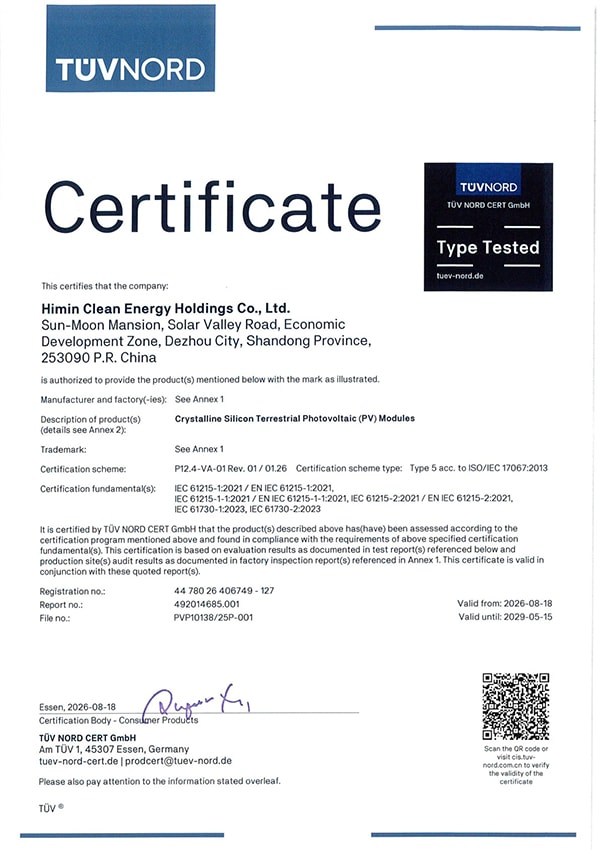
● IEC 61215:2021 PV Module Design Qualification and Type Approval
● IEC 61730:2023 PV Module Safety Qualification
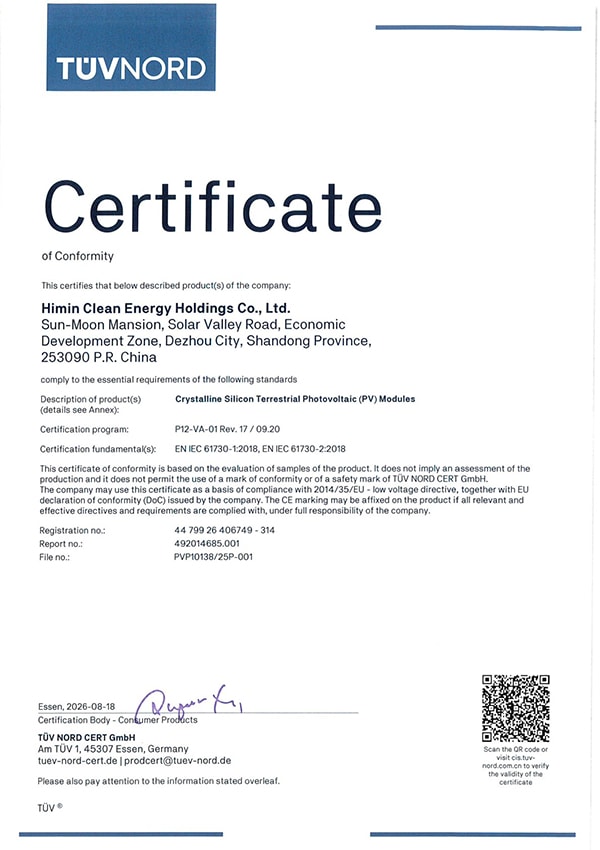
CE Certificate of Conformity
TÜV NORD Certificate
Temperature Ratings
Temperature Coefficient of Pmax
−0.290%/°C
Temperature Coefficient of Voc
−0.250%/°C
Temperature Coefficient of Isc
+0.045%/°C
NMOT (Nominal Module Operating Temperature)
41 ± 3 °C
Why choose Himin?
1. Himin has the world's largest private solar energy technology testing center with 20 laboratories in which 1326 testing items can be completed. Himin owns more than 430 enterprise standards, yet there are less than 20 national standards and less than 50 international standards. On January 6, 2009, Himin was certified by the China National Accreditation Service for Conformity Assessment (CNAS) and the testing report Himin issues has the same effect as the national testing report. Himin also introduced advanced testing equipment from German Olbricht to conduct rigorous technical testing on the solar modules.
2. Himin prefers raw materials which are from internationally renowned suppliers and certified by TUV and UL. The raw materials, like EVA film, TPT backsheet, tempered glass, solar cell, tin-plated copper strip, etc., must undergone sixteen rigorous tests, so as to ensure the quality of the finished products.
EVA film testing: crosslinking degree test, shrinkage test, peel strength test, light transmittance test, UV aging test, and damp heat test;
TPT backsheet testing: peel strength testing, UV aging test, insulation experiment, and dimensional stability test;
Tempered glass testing: impact resistance test, debris experiments, light transmittance experiment;
Solar cell testing: electric property test, busbar adhesion test;
Tinned copper strip testing: resistance test.
3. For the finished solar modules, we have the following eight technical tests:
Electrical performance testing, insulation test, thermal cycle test, ultraviolet test, clamminess test, damp heat test, bypass diode thermal test, and simulated weathering test.
Shandong Himin Lvxi Energy Technology Co., Ltd. Himin Solar Co.,Ltd.
Himin Clean Energy Holdings Co.,Ltd
Add.: Sun-Moon Mansion,Solar Valley Road,Economic Development
Zone,Dezhou City,Shandong,China.
For business:
Headquarters: Add: Sun-Moon Mansion,Solar Valley Road,Economic Development
Zone,Dezhou City,Shandong,China. Post code: 253000 Mobile:+86-13365345435 E-mail: himinguofeng@126.com info@himin.com Website: www.himinsun.com